
Top Platforms for Various Objectives
Because each social media site has its own advantages, some are more suited for conversions, engagement, or brand visibility.
Social Media Platforms
involves utilizing platforms like Instagram, Facebook, TikTok, LinkedIn, YouTube, and X (previously known as Twitter) to advertise products or services, enhance brand recognition, interact with audiences, and achieve quantifiable business results.
Social commerce is anticipated to surpass $100 billion in the United States, rendering shoppable content an essential element of any social media marketing strategy.
Social media marketing leverages platforms such as Instagram, Facebook, TikTok, LinkedIn, and YouTube to link brands with their audiences, enhance engagement, and boost revenue.
An effective social media marketing strategy begins with the establishment of SMART goals, thorough audience research, competitive analysis, and the development of a content calendar.
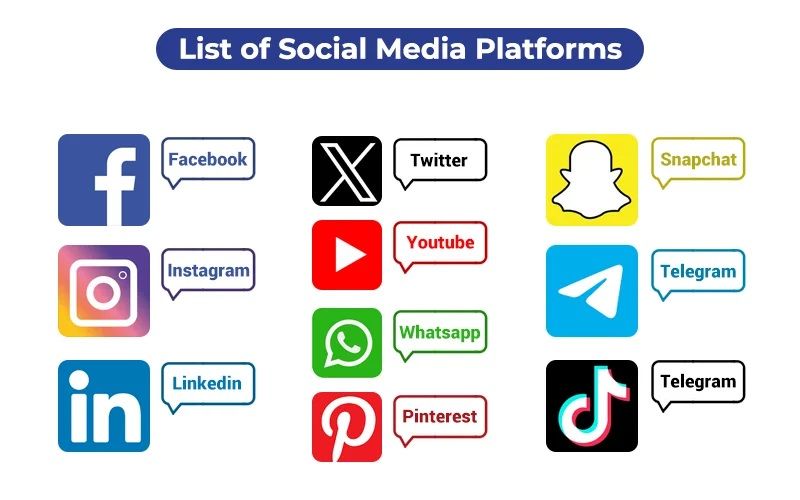
Here are seven widely utilized social media platforms in contemporary society:
some of the social media platforms
- Facebook – The largest social media network, boasting over 3 billion monthly active users, facilitates connections, content sharing, and community engagement.
- Instagram – A platform dedicated to photo and video sharing, with over 2 billion monthly active users, recognized for its visual content and Stories feature.
- YouTube – A video-sharing service with more than 2 billion monthly active users, enabling individuals to upload, share, and view videos on diverse subjects.
- WhatsApp – A messaging application with over 2 billion users, supporting text, voice, and video communication, along with file sharing.
- TikTok – A rapidly growing short-form video platform, attracting over 1 billion monthly active users, particularly among younger demographics.
- Twitter (now X) – A microblogging service with approximately 450 million monthly active users, celebrated for its real-time updates and trending topics.
- LinkedIn – A professional networking platform with over 900 million users, concentrating on career advancement, job searching, and professional networking.
- These platforms encompass a variety of social networking, content sharing, and communication tools that address different user requirements and preferences.

Choosing a Social Media Marketing Agency is the process of evaluating, vetting, and partnering with an external team to manage, scale, and optimize your brand’s presence across digital platforms. Because you are handing over the public voice and identity of your business, making the right choice requires aligning your internal goals with the agency’s specific creative, technical, and strategic capabilities.
1. Define Internal Objectives and Budget
Before contacting any agency, establish clear parameters for what you want to achieve:
- Business Goals: Move beyond vague metrics like “more followers” and define concrete targets (e.g., generating qualified B2B leads on LinkedIn, driving direct-to-consumer sales via Instagram, or building regional brand awareness).
- Scope of Work: Determine what you need offloaded—whether it is end-to-end content creation, graphic design, video production (Reels/Shorts), community management, or paid ad campaigns.
- Total Budget: Account for the full financial commitment, including monthly retainers, content production costs, and dedicated ad spend.
2. Evaluate Expertise and Portfolio Relevance
Not all agencies specialize in the same areas. When reviewing prospective partners, look for:
- Industry Proximity: Experience in your specific sector or a closely adjacent market.
- Platform Specialization: Proven capability on the channels that matter most to your target audience (e.g., short-form video for B2C versus professional thought leadership for B2B).
- Results Over Aesthetics: Beautiful graphics are table stakes; examine case studies to see how their work directly impacted key performance indicators (KPIs) like return on ad spend (ROAS), lead volume, or organic growth.
3. Conduct Discovery and Ask Deep-Dive Questions
Use discovery calls to move past generic pitch decks and evaluate how they operate. Consider asking:
social media platforms relatives
- Who will be our day-to-day point of contact, and what does the content approval workflow look like?
- What is your initial strategy or framework for achieving our stated goals?
- What metrics do you track, and what does your standard reporting structure look like?
4. Review Contracts and Terms on Social Media Platforms
Before signing, protect your investment by thoroughly clarifying the legal and operational agreements:
- Deliverables: Exactly how many posts, videos, or campaigns are guaranteed per month?
- Ownership: Ensure your business retains full ownership of all creative assets, ad accounts, and social channels.
- Exit Clauses: Understand contract lengths, trial periods, and cancellation policies if performance benchmarks aren’t met.
Key Takeaways: Social Media Marketing
Mastering social media marketing requires shifting focus from simple vanity metrics to driving tangible business value. Here are the core principles to keep in mind:
1. Quality Outweighs Quantity
- Consistency over Overload: Posting constantly with low-value content dilutes your brand. Instead, focus on a sustainable posting schedule filled with high-value, highly engaging content.
- Platform-Specific Optimization: Avoid cross-posting the exact same content across every channel. Tailor your formats, tone, and messaging to fit the unique culture and algorithm of each platform (e.g., professional insights for LinkedIn, visual storytelling for Instagram).
2. Community and Engagement Drive Growth
- Two-Way Conversations: Social media is a dialogue, not a broadcast channel. Actively responding to comments, DMs, and mentions builds brand loyalty and humanizes your business.
- Algorithm Favorability: Major platforms heavily reward content that generates active discussions, shares, and saves within the first hour of posting.
3. Data-Driven Strategy Wins
- Track Meaningful KPIs: Move past follower counts and likes. Focus on metrics that tie directly to your bottom line, such as click-through rates (CTR), conversion rates, cost per acquisition (CPA), and return on ad spend (ROAS).
- Continuous A/B Testing: Regularly test different hooks, visuals, call-to-actions (CTAs), and posting times to refine your strategy based on actual audience behavior.
4. Paid and Organic Synergy
- Amplifying Reach: While organic social builds long-term brand equity and community, organic reach alone is often heavily restricted by platform algorithms.
- Targeted Paid Ads: Integrating paid social advertising allows you to precisely target new audiences, retarget engaged website visitors, and scale successful organic content rapidly.